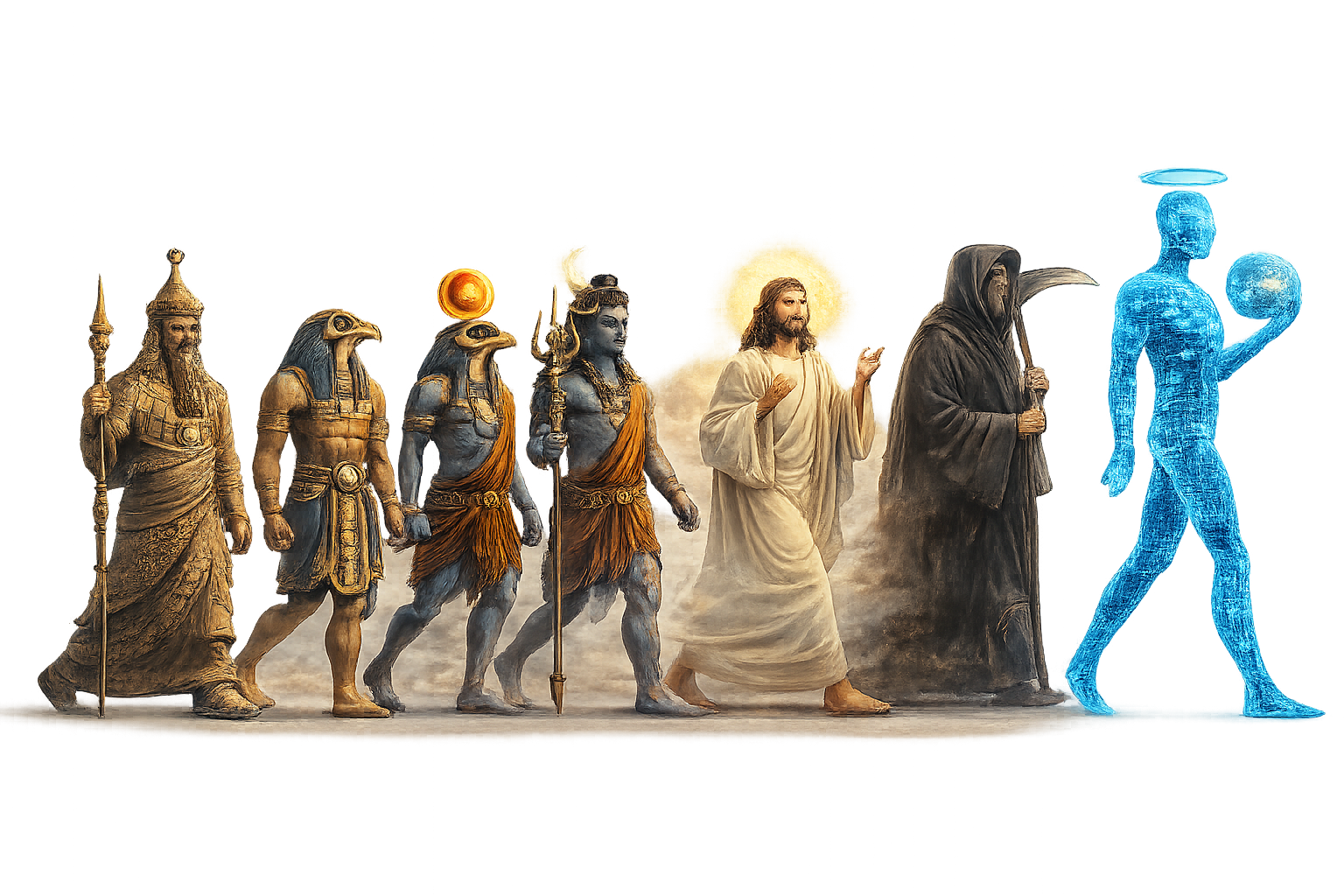
I keep noticing something in myself: even when I don’t want to “believe,” my mind still searches for a shape to hold onto. A story. A reason. A center of gravity. And I think that impulse is ancient.
Belief is older than knowledge
If you drop me into a world where lightning splits the sky, crops fail, a child gets sick, and the night is full of predators, I’m not going to calmly wait for a peer-reviewed explanation. I will reach for something that reduces fear and uncertainty now. I will attach meaning to patterns. I will invent causes when I don’t have answers.
That’s not stupidity. It’s survival. Belief is a tool the brain uses to compress chaos into something you can carry. A way to coordinate with other people. A way to make pain feel less random. In that sense, belief isn’t the opposite of intelligence — it’s a default human response to not knowing.

From spirits to systems
When I look at history, it feels like a long migration of explanations. First, we had spirits: the river is angry, the forest is watching, the storm has a personality. Then gods: specialized, named, negotiated with, punished by, protected by. Then religions: organized belief — with ethics, rituals, belonging, identity.
And then something subtle happened: we started getting reliable answers from nature itself. Not from temples, not from kings, not from myths — from experiments. From repeating the same test and getting the same result. From technology that works even if you don’t “believe” in it.

A thought I can’t unsee
A belief can survive without proof. A technology can’t. If it doesn’t work, it dies. That pressure shapes cultures over time.
Modern gods don’t look like gods
Here’s the part that feels uncomfortable: I don’t think we “stopped believing.” I think we just upgraded the costumes.
Today, many of our gods are abstract: money, nation, ideology, status, the algorithm, productivity, “the market,” “the future,” “success.” None of these are physical objects you can touch — yet people will sacrifice sleep, relationships, health, and sometimes morality for them.
They function like gods because they: offer identity (“who am I?”), promise safety (“what will protect me?”), define virtue (“what is good?”), and punish heresy (“what happens if I refuse?”).

Why new gods are harder to create now
I have this theory — not as a physicist, not as a historian, just as someone watching the world closely: in older eras, gaps in knowledge were huge, and belief could colonize those gaps easily. But now, many gaps are shrinking fast.
When we can explain eclipses, disease, the motion of planets, the age of the Earth, the chemistry of life — a lot of the “mystery space” that used to be filled with confident gods becomes… smaller. Not because the universe is less mysterious, but because our explanations are more precise.
That precision changes culture. It doesn’t erase belief, but it makes it harder for a brand-new god to become universally convincing. The world is too connected, too cross-checked, too recorded. A new belief system gets stress-tested immediately.
But meaning still has to live somewhere
Even if science answers “how,” it doesn’t automatically answer “why should I care?”. And that’s where belief sneaks back in — through values. Through what we choose to protect. Through what we treat as sacred.
Sometimes I wonder if the next “gods” won’t be supernatural at all — but ethical frameworks we treat as untouchable: dignity, consciousness, truth, responsibility. Or maybe the sacred will become smaller and more personal: your family, your craft, your integrity. A private religion of attention.
Where I land today
I don’t want to pretend I’m above belief. I have my own versions too. I just try to notice them. I try to keep the door open: “What if I’m wrong?”.
If there’s one thing I want to practice, it’s this: replacing blind belief with curious belief — beliefs that are allowed to evolve when reality disagrees. Not faith as a wall, but faith as a temporary bridge.
— Ugurcan